Why misunderstanding RFID and NFC disrupts your project
Misjudging the capabilities of RFID and NFC often leads to misaligned expectations and wasted budgets across your entire operation. When you design a system based on theoretical assumptions rather than physical realities, you risk purchasing hardware that cannot perform in your specific environment. Your team might expect to track assets continuously across a massive facility, only to discover that the chosen tags require close physical proximity to function. Clarifying these technical boundaries early in your planning phase ensures you choose the right tools for your unique use case.
The realities of tracking distance and reading range
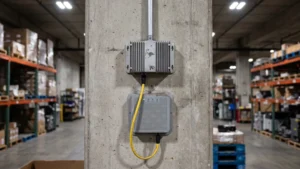
Evaluating the true scanning distances of your chosen technology ensures your system operates reliably under everyday warehouse or office conditions. The physical environment heavily influences how well these systems harvest power and transmit data back to your central records. Understanding the fundamental mechanics of electromagnetic coupling, which is the physical method used to transfer energy between a tag and a reader, helps you identify exactly where standard tags will succeed. You can then confidently map out reader placements that accommodate your actual inventory flow and facility layout.
How RFID differs from global positioning systems
RFID does not provide real-time global positioning because it relies on fixed local readers rather than continuous satellite signals. An RFID tag simply stores an identification number and answers what is passing a specific point rather than mapping exactly where an item travels. When an asset moves past a checkpoint, the reader scans the tag and records its presence at that specific doorway or shelf. Because passive tags lack internal batteries, they only wake up when they absorb energy from a nearby reader signal. This limitation means you must install physical infrastructure at every point you wish to monitor, creating discrete logs rather than continuous location tracking.
Why NFC requires close physical proximity
NFC operates through magnetic induction, meaning the reader and the tag must remain extremely close to transfer power and data effectively. The magnetic field strength drops off rapidly as distance increases, severely limiting the energy available to wake up a passive tag. Under normal conditions, you must bring the reader within a few centimeters of the tag to successfully capture the stored information. If you attempt to scan a tag from further away, the magnetic field lines miss the antenna surface area entirely and the system fails to register the interaction. This short range provides excellent security for access control and payments, but it completely rules out any application where you need to scan items from across a room.
Steps to align your team and suppliers on technology facts
Building a realistic project scope requires clear communication between your internal team and your hardware suppliers. When you translate technical realities into actionable requirements, you prevent the confusion that stems from misused terminology. Following a structured sequence ensures every stakeholder understands exactly what the system can achieve within your specific physical environment. You can use these practical steps to guide your vendor discussions and secure the right equipment for your daily operations.
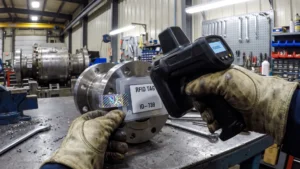
- Audit the physical environment: Document the layout of your facility and note specific areas where heavy metals or liquids might interfere with signal transmission. This concrete information helps you and your suppliers identify whether you need specialized tags to overcome environmental barriers. Gathering these details early prevents unexpected dead zones when you finally deploy the hardware. You can then allocate your budget toward the correct protective equipment from the very beginning.
- Define the target read distance: Calculate the exact physical gap required between your readers and your assets during normal operations. Sharing this precise measurement prevents suppliers from quoting systems that rely on theoretical maximums rather than practical realities. A clear distance requirement guarantees your final setup matches the physical limitations of your workspace. This step ensures your team never installs a reader too far away to capture critical data.
- Specify the interaction type: Determine whether your process requires continuous checkpoint logging, intentional close-proximity scanning, or bulk inventory reads. Clarifying this workflow ensures you select the correct technology standard before you commit to expensive infrastructure changes. This alignment protects your budget from unnecessary upgrades later in the project lifecycle. Matching the interaction type to your daily habits reduces friction for the staff operating the system.
- Finalize vendor communications: Present your audited environment, distance requirements, and workflow needs in a unified brief for your technology partners. This direct approach eliminates guesswork, builds internal confidence, and guarantees your chosen supplier delivers hardware that fits seamlessly into your existing processes. Clear guidelines empower your vendors to design a solution that truly solves your operational challenges. Your project moves forward smoothly when every stakeholder shares the exact same technical understanding.
Can RFID track items in real time like GPS?
No. Radio-Frequency Identification (RFID) confirms identity when a tag passes a nearby RFID reader, while the Global Positioning System (GPS) calculates location continuously via satellites. RFID creates checkpoint logs, not live coordinates. Continuous tracking with RFID would need dense reader coverage and still stays local.
How far can NFC actually work in real deployments?
Near Field Communication (NFC) typically works within 1 to 5 centimeters. It uses magnetic induction, so power falls off quickly with distance. An industrial NFC reader and larger tag antennas can stretch that to about 10 to 20 centimeters, and some vicinity-oriented 13.56 MHz tags can approach 1 meter.
Why do UHF RFID tags perform poorly near metal or water?
Ultra High Frequency (UHF) Radio-Frequency Identification (RFID) uses radio waves that reflect from metal and are absorbed by water, which weakens the signal. Use on-metal tags or spacers, align antennas carefully, and place the RFID reader to avoid strong reflections. Test on site to confirm results.
Is NFC the same thing as RFID?
No. Near Field Communication (NFC) is a specific form of high frequency Radio-Frequency Identification (RFID) designed for very short range and two-way communication with phones and cards. RFID is broader and also includes long range systems. Choose NFC for taps, and other RFID for distance.
Will an RFID reader pick up every tag in the room?
Not by default. Radio-Frequency Identification (RFID) that operates at short range reads only tags brought very close to the RFID reader. Ultra High Frequency (UHF) systems can read many tags across meters, but you can confine reads by lowering power, using directional antennas, and adding shielding.